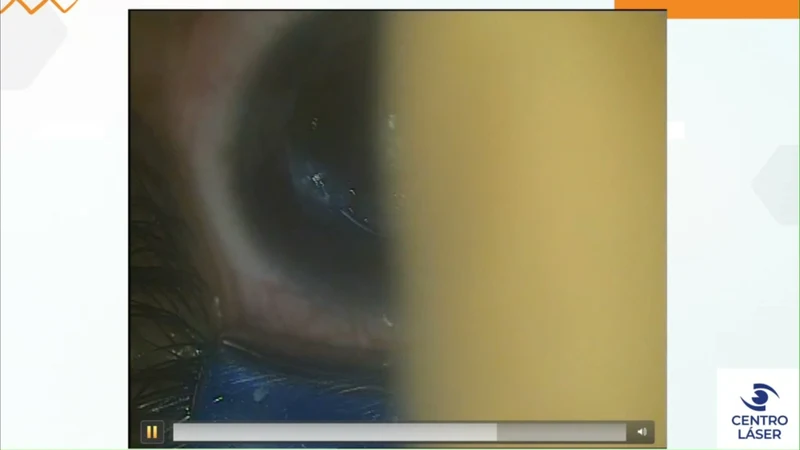
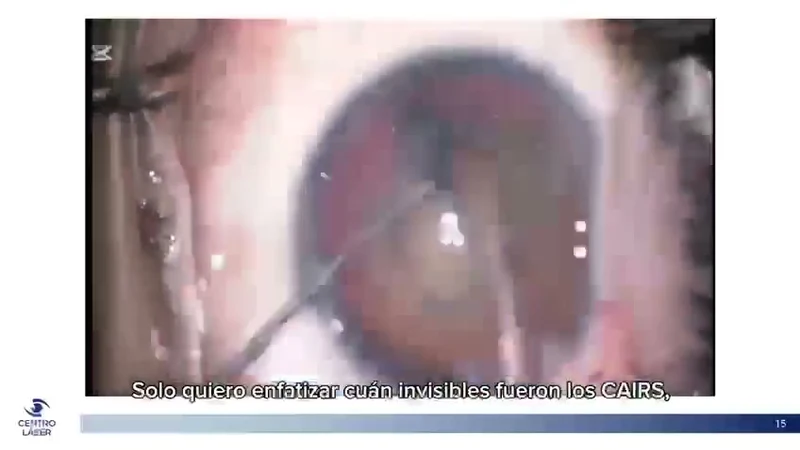
A 27-year-old patient came to my office with a complaint that had gone unresolved for months: intense photophobia, watery eyes, inability to tolerate daylight. Allogenic corneal segments (CAIRS) had been placed five months earlier at another center as treatment for her bilateral keratoconus. Her vision had initially improved, but the persistent photophobia was not responding to topical corticosteroids. On examination we found segments with visible folds, tissue folded on itself, and an opacity that should not have been there. Anterior segment OCT confirmed what we suspected: segments of unusually high thickness and an irregular configuration within the corneal tunnel. The diagnosis was excess segment volume, which was producing chronic stretching of the corneal nerves and the neurogenic irritation that explained the photophobia.
Eight months after reintervention, where we reduced segment thickness and repositioned them within the same tunnel, the photophobia had disappeared and the cornea was structurally stable. This type of case is uncommon but highly educational, because it shows how a technical deviation in tissue preparation can turn an effective procedure into a source of chronic symptoms. Severe CAIRS complications reported in the literature are infrequent (0.2% in the Friedrich et al. 2025 meta-analysis reviewing 442 eyes), but when they occur they usually stem from deviations from the original technical principles described by Soosan Jacob. What follows is the case narrative and the technical pearls that prevent this situation.
What a patient should feel after a CAIRS implant
In a normal postoperative course following CAIRS, the patient experiences mild foreign body sensation, tearing, and light sensitivity during the first few days. These symptoms subside progressively and in most cases resolve within two to three weeks. Vision improves gradually and stabilizes between the first and third month.
What should not happen is photophobia that persists for months after surgery, persistent opacity of the segments, or visible folds in the implanted tissue. Those three findings are signals that something has deviated from the technically correct procedure. When a CAIRS patient remains photophobic three months after surgery, that complaint deserves a second opinion and not an indefinite extension of anti-inflammatory drop therapy.
The case: 27-year-old woman with photophobia refractory to treatment
The patient presented with bilateral keratoconus and a clear clinical history. In February 2025 she underwent bilateral CAIRS implantation at another center, using a manual technique for tissue preparation. Immediate progression was good visually: visual acuity improved and topography showed regularization of the corneal curvature, consistent with what a properly indicated CAIRS should achieve.
The problem came later. Over the following months she developed intense and persistent photophobia, with no improvement from the topical corticosteroids she was prescribed. In July 2025, five months after the original surgery, she sought a second opinion because the symptom was preventing her from carrying out a normal life.
What we found on examination
Slit lamp biomicroscopy was immediately striking. The intrastromal segments showed:
- Visible folds in the tissue
- Appearance of tissue folded on itself
- Abnormal opacity, when the expected appearance is semitransparent once the initial edema has resolved
Refractive and intraocular pressure data at the time of evaluation:
| UCVA | Refraction | BCVA | IOP | |
|---|---|---|---|---|
| OD | — | −1.25 −7.50 × 10 | 20/70 | 18 mmHg |
| OS | — | +5.00 | 20/60 | 17 mmHg |
Vision had improved compared to her pre-CAIRS state, but residual astigmatism was still high and photophobia limited the functional use of that vision.
What the studies showed
Visante anterior segment OCT was the piece that closed the diagnosis. The segments appeared with unusually high thickness, well above the commonly recommended range, and with an irregular configuration within the corneal tunnel, consistent with tissue that had not been prepared to uniform dimensions. Corneal topography, in contrast, showed improvement relative to the underlying keratoconus. That explained why vision had initially improved: the segments were flattening the cornea. But they were doing so with too much material.
The diagnosis
The clinical combination aligned with a clear picture:
- Excess volume in the allogenic segments (confirmed by OCT)
- Chronic stretching of the corneal nerves (mechanical cause of the photophobia)
- Sustained neurogenic irritation (symptomatic explanation consistent with refractoriness to corticosteroids)
Corneal nerves are the densest nerve endings in the human body. When an intrastromal segment exceeds the volume for which the tunnel was designed, the cornea responds by stretching the nerves surrounding the implant. That stretching does not switch off with an anti-inflammatory: it is a persistent mechanical stimulus.
Why a segment that is too thick causes photophobia
The technical design of CAIRS, as described by Soosan Jacob in her original 2018 publication, contemplates segments of specific thickness and regularity so that the cornea accommodates them without deforming. When those parameters are exceeded, the local stroma tightens around the implant. That sustained mechanical tension affects the sensory nerves that cross the stroma and produces a picture of neurogenic irritation.
Photophobia is the most visible manifestation of that phenomenon, but it is not the only possible consequence. Although infrequent, the literature describes other potential complications of intrastromal segments that can also appear with CAIRS:
- Anterior stromal melt overlying the segment, well documented in synthetic ICRS and rarely reported with CAIRS in specific contexts such as severe inflammation or atopy
- Segment extrusion toward the corneal surface (0.5% in the Friedrich et al. 2025 meta-analysis with CAIRS, versus up to 30% historically reported with some synthetic ICRS)
- Halos and night glare due to optical defects in the area of the implant
An important clarification is worth making: these complications are significantly less frequent with allogenic tissue (CAIRS) than with synthetic PMMA segments. The biocompatibility of human tissue and its integration with the stroma largely explain that better safety profile. The good news is that, when they do appear, they are preventable with correct technique and correctable with early reintervention. CAIRS are not a capricious material. They behave very well when prepared and placed within the original parameters.
The reintervention: how the case was corrected
Surgery was performed on August 7, 2025, bilaterally. The goal was not to remove the segments and replace them with new tissue, but to reduce the thickness of the existing segments and reposition them within the same corneal tunnel. That strategy took advantage of the integration that had already occurred between the donor tissue and the recipient stroma, avoiding the additional trauma of a complete tunnel re-cut.
The procedure was uneventful in both eyes. Immediate recovery was as expected for corneal surgery: mild discomfort during the first 48 hours, follow-up with anti-inflammatory and antibiotic drops, and scheduled reviews.
Results at 8 months postoperative
| UCVA | Subjective refraction | BCVA | IOP | |
|---|---|---|---|---|
| OD | 20/60 | −0.75 −0.50 × 10 | 20/40 | 12 mmHg |
| OS | 20/100 | plano −1.75 × 90 | 20/50 | 10 mmHg |
Clinical findings on examination were consistent with a well-integrated CAIRS: semitransparent segments, adequate thickness, no folds or tissue deformation, structurally stable cornea. Most importantly from the patient's point of view: complete resolution of photophobia. A mild residual picture of occasional dry eye remains, which does not interfere with normal life and is managed with artificial tears.
Technical pearls to avoid this complication
This is the educational core of the case. CAIRS complications due to excess volume or inadequate tissue preparation are avoidable if four technical principles are respected, which we apply systematically in our practice:
1. Tissue from the mid-peripheral cornea, not from the limbus
The corneolimbal edge has a histology different from the central stroma. It includes limbal stem cells and tissue with a different response to intrastromal integration. Segments are prepared from the mid-peripheral cornea, where the stroma has the biomechanical and optical characteristics appropriate for integration as an implant.
2. Specialized double trephines for uniform preparation
Manual technique without specialized trephines can produce segments with irregular dimensions. Double trephines specifically designed for CAIRS guarantee uniform edges and homogeneous thickness along the entire length of the segment. It is the difference between a predictable implant and one that may have thicker areas producing localized tension points.
3. Strictly controlled segment thickness: ≤ 500-600 microns
The therapeutic range for CAIRS segment thickness lies between 300 and 600 microns depending on the case. Systematically exceeding 600 microns is entering a risk zone for neurogenic photophobia and mechanical complications. The practical rule in our practice is that if the preoperative calculation calls for a segment larger than that range, flattening is redistributed with two smaller segments instead of a single thick one.
4. Regular segment with partial transparency after edema resolution
In the immediate postoperative period, CAIRS segments are edematous and appear opaque. That edema subsides during the first few weeks and the tissue adopts a stable semitransparent appearance. If at three months opacity persists or visible folds remain, that is a signal that something is not right and warrants complementary studies.
Respecting these four principles makes CAIRS a procedure with the safety profile reported in the literature: the Friedrich et al. meta-analysis in American Journal of Ophthalmology (2025), which reviewed 14 clinical studies with 442 eyes, reported a severe complication rate of 0.2%. That figure corresponds to the technique performed correctly, not to its improvised form.
When to seek consultation if you have CAIRS placed
If you have CAIRS implanted and present any of these pictures beyond the first postoperative month, consult a cornea specialist for evaluation:
- Intense photophobia that does not improve with topical corticosteroids
- Persistent opacity of the segments, visible when looking in the mirror or reported by your physician
- Constant foreign body sensation that does not subside over the weeks
- Severe glare when driving at night
- Gradual loss of the vision gained after surgery
Not all of these symptoms indicate a serious problem, but they all justify an evaluation with complementary studies (detailed biomicroscopy, anterior segment OCT, topography). In most cases, the corrective intervention is performed using the same existing corneal tunnel, without the need for more extensive procedures.
Frequently asked questions
Can CAIRS be removed if they are the problem?
Yes, CAIRS are reversible. The segments can be completely removed and the cornea largely returns to its preoperative shape. However, when the problem is one of volume or preparation (as in this case), the usual approach is to reduce segment size and reposition them, not to remove them entirely, because their corneal regularizing effect is something one wants to preserve.
How long after CAIRS is photophobia normal?
Light sensitivity during the first one or two weeks is expected and part of the normal postoperative course. After the first month it should have almost entirely subsided. If it persists with intensity at three months, it is no longer part of the normal course and warrants specific evaluation.
Is this type of complication common?
No. Severe CAIRS complications are infrequent (0.2% in the most recent meta-analysis). When they do occur, there is almost always an identifiable technical deviation: excessive segment thickness, tissue preparation outside the mid-peripheral cornea, use of non-specialized trephines. When technical principles are respected, the safety profile is very favorable.
Can photophobia recur after correction?
In our experience it does not, provided that the reintervention corrects both structural causes: excessive thickness and irregular segment positioning. At 8 months after correction in this patient, photophobia had resolved and the segments remained semitransparent and stable.
Can any ophthalmologist perform this reintervention?
Correction of an improperly sized CAIRS is an advanced corneal procedure that requires specific experience with intrastromal segments. It is not a routine cataract surgery. Seek a cornea specialist with documented experience in CAIRS and in the rescue of complications.
What this case makes clear
Allogenic corneal segments are an effective and safe technique when the principles of their original design are respected: tissue prepared from the mid-peripheral cornea, specialized double trephines, thickness ≤ 600 microns, regular and transparent segment after edema resolution. When those principles are respected, CAIRS does what it is supposed to do: regularize the cornea without leaving chronic symptoms.
When something deviates from that, the cornea communicates it. Persistent photophobia is one of those communications and deserves technical, not merely pharmacological, attention. The good news is that most of these situations are corrected without removing the segments, and the medium-term result is usually very satisfactory.
If you have CAIRS placed and have had months of symptoms that do not subside, or if you are a colleague managing post-CAIRS cases and encounter a similar picture, an evaluation with complete studies is worthwhile. In most cases, the solution exists and is less invasive than it appears.
About the author
Dr. Juan F. Batlle Logroño is an ophthalmologist specializing in cornea and refractive surgery. A medical graduate of Tulane University and Fellow of the Bascom Palmer Eye Institute, he is Co-Director of CCCRP and Medical Director of the Dominican Republic Cornea Bank. He practices at Centro Láser, an ophthalmology institution with more than 50 years of experience in the country, where he leads the CAIRS program and trains fellows in cornea and refractive surgery. His practice integrates complex technical rescue cases, including visual reconstruction after penetrating keratoplasty with CAIRS and cataract surgery with intraocular lens after CAIRS in keratoconus.
Disclaimer
This content is for educational and informational purposes. It does not replace consultation, diagnosis, or professional ophthalmologic treatment. The symptoms described can have multiple causes and only a specialist can evaluate your specific case. The results described correspond to a specific patient and may vary depending on each person's clinical conditions.
References
- Jacob S, Patel SR, Agarwal A, et al. Corneal Allogenic Intrastromal Ring Segments (CAIRS) Combined With Corneal Crosslinking for Keratoconus. Journal of Refractive Surgery. 2018;34(5):296-303. DOI: 10.3928/1081597X-20180223-01. PMID: 29738584.
- Friedrich M, Auffarth GU, Soiberman U, Augustin VA, Khoramnia R, Son HS. Visual and Topographic Outcomes After Corneal Allogeneic Intrastromal Ring Segments for Keratoconus: A Systematic Review and Meta-Analysis. American Journal of Ophthalmology. 2025;276:81-91. PMID: 40157443.
- Levy I, Mukhiji R, Nanavaty MA. Corneal Allogenic Intrastromal Ring Segments: A Literature Review. Journal of Clinical Medicine. 2025. PMID: 40004870.
- Anterior stromal melt after CAIRS implantation in a patient with atopy. Cornea. 2025. PMID: 40095577.
- Kirgiz A, et al. Clinical outcomes of corneal allogenic intrastromal ring segments for keratoconus. Clinical and Experimental Ophthalmology. 2024. PMID: 38938058.
Last updated: April 17, 2026