A 41-year-old patient came to my clinic at Centro Láser with two corneal transplants performed 17 years earlier. The grafts were clear, without a single visible suture, but visual acuity (VA) in the left eye was 20/200. The Pentacam showed 9.6 diopters of irregular astigmatism within the graft. I proposed placing two segments of human corneal tissue (CAIRS) inside the transplant to regularize the cornea, a procedure for which we found no prior peer-reviewed report in this specific context. Six weeks after surgery, his best corrected visual acuity went from 20/200 to 20/50 and higher-order aberrations dropped by 66%.
This case, presented at the Bani Congress and at the interamerican course of the Bascom Palmer Eye Institute, co-authored by Dr. Martha Aguirre (cornea and refractive surgery fellow at Centro Láser) and myself, marks the first CAIRS implant inside a penetrating keratoplasty in the Dominican Republic. What follows is the full clinical journey and why we believe this combination opens a door for a group of patients who, until now, had very few alternatives.
Why a corneal transplant can still see poorly
Penetrating keratoplasty (PKP), a full-thickness corneal transplant, resolves the underlying disease but does not guarantee good vision. Many patients with clear, stable grafts discover years later that they see worse than expected. The most common reason is residual irregular astigmatism.
During graft healing, suture tension and the way the graft integrates with the recipient cornea generate distortions of the optical surface. When all sutures are removed, sometimes several years after surgery, those distortions can increase rather than resolve. The result is a cornea that lets light through without difficulty, but does not focus it properly.
Post-keratoplasty astigmatism is one of the most frequent causes of visual dissatisfaction after a transplant. Until recently, the alternatives were limited. Rigid contact lenses are not always tolerated. Arcuate relaxing incisions have variable efficacy in high astigmatism. A second partial transplant is a major procedure, with its own complication curve and a new healing period of several years.
What CAIRS are and why they fit in this scenario
CAIRS (corneal allogenic intrastromal ring segments) are pieces of human corneal tissue inserted into the cornea to flatten and regularize it. They are the biological alternative to synthetic rings (ICRS), which have been used for decades but which the eye always recognizes as a foreign body. For those who want to dive into the technical detail, I previously wrote a complete guide on CAIRS as a treatment for keratoconus where I explain why human tissue outperforms plastic in biocompatibility.
The reason CAIRS make sense inside a previous graft is twofold. First, allogenic tissue integrates with the graft stroma without triggering the chronic inflammatory reaction that ICRS sometimes produce. Second, as human tissue, it behaves mechanically more like the surrounding cornea: it flattens where it needs to flatten without creating rigid pressure points.
Until this case, the literature on CAIRS had focused on primary keratoconus and on corneal ectasia following refractive surgery. The original technique described by Soosan Jacob in 2018 (published in Journal of Refractive Surgery) opened the field. A meta-analysis published in American Journal of Ophthalmology (Friedrich et al., 2025) reviewed 14 clinical studies with a total of 442 eyes treated with CAIRS and confirmed consistent improvements in corrected visual acuity, spherical equivalent, and maximum keratometry, with a severe complication rate of 0.2% (a single case of acute rejection requiring explantation). Those numbers are the basis on which we supported the decision in this case, although the initial reports did not cover the scenario of a previous graft.
An important clarification is in order: synthetic rings (ICRS) inside penetrating keratoplasty have been documented in the literature for years. What is new here is using human allogenic tissue in that same context, a material distinction that changes the biomechanical and biocompatibility profile of the implant.
The case: a patient with bilateral keratoconus, 17 years post-transplant
The patient, whom we will identify as RAR, came to the clinic with a direct request: to see better with his left eye. His visual history started in childhood, with bilateral keratoconus, and continued with rigid contact lenses during adolescence. Seventeen years ago he received penetrating keratoplasty in both eyes and since then had lived with limited vision.
Preoperative evaluation
On examination we found the following:
| UCVA | Manifest refraction | BCVA | |
|---|---|---|---|
| OD | 20/100 | -2.00 -3.75 x 120 | 20/40 |
| OS | 20/200 | -2.50 -4.00 x 70 | 20/200 |
Both corneal buttons were clear, without remaining sutures. The right eye showed a discrete step in the inferior nasal periphery of the graft, and the left eye a mild superonasal step. Intraocular pressure was normal (13 mmHg in the right, 15 mmHg in the left) and the optic nerves appeared healthy.
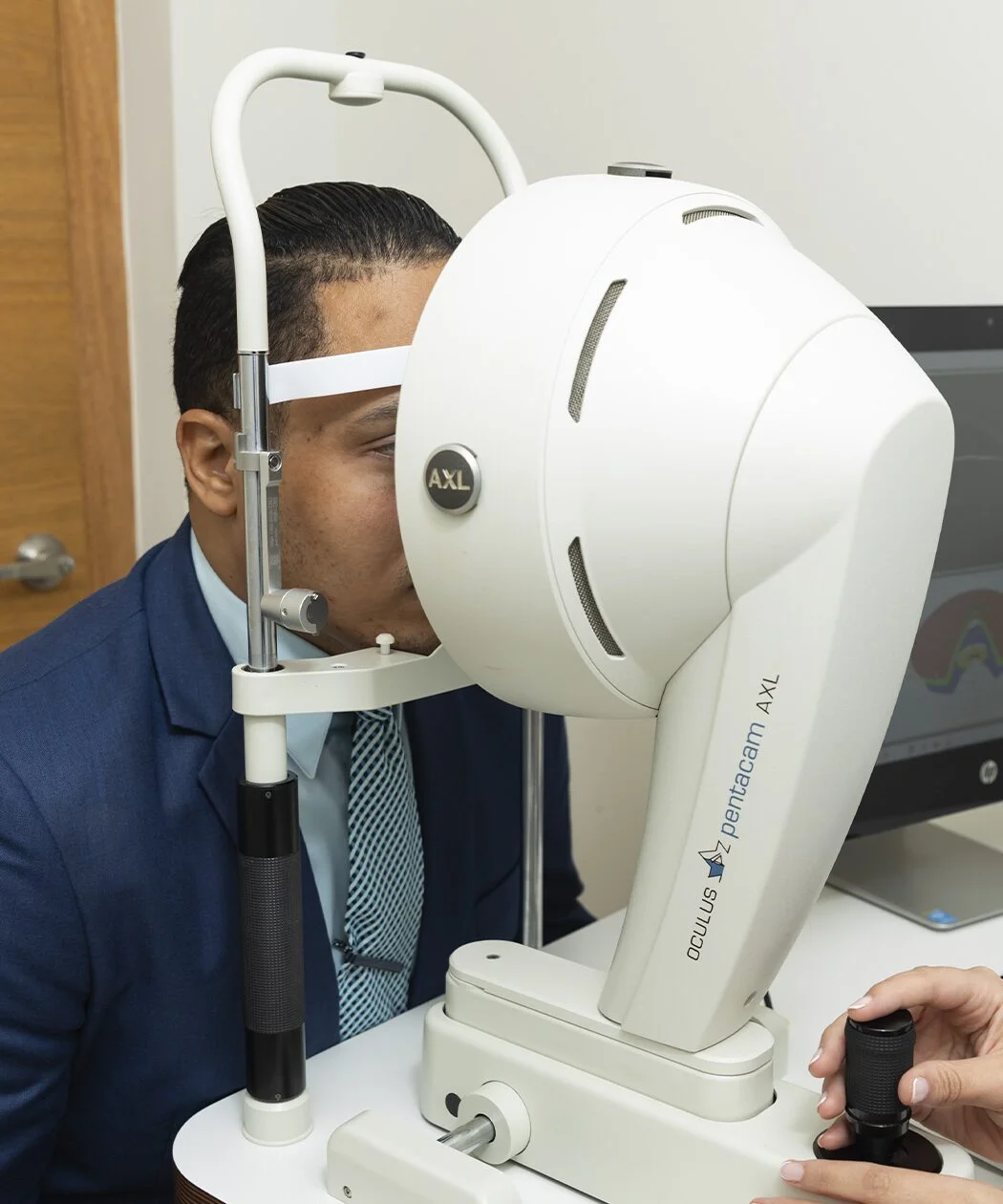
The problem was clearly visible on the Pentacam. The irregular astigmatism of the left eye reached 9.6 diopters, with high coma and marked astigmatic elevation. That explained why the patient could not achieve more than 20/200 with his best correction: the cornea was distorting light before it reached the retina, and that distortion was not simple refractive error but irregular.
The surgical decision
We had several reasons to attempt CAIRS instead of the conventional alternatives. The graft was structurally stable with 17 years of follow-up, relaxing incisions correct up to a certain degree but 9.6 diopters of irregular astigmatism is beyond their reach, and a repeat transplant meant exposing the patient to another major surgery when there was room for something less invasive. Also weighing in favor of CAIRS was that human tissue reduces the risk of inflammation inside a graft that is, by definition, already donor tissue.
Planning relied on the Pentacam topographic map and iTrace aberrometry analysis. We chose two 500-micron segments, one at 110 degrees and another at 60 degrees, to align them with the axes of greatest coma and astigmatic elevation.
The procedure step by step
Surgery was performed on December 18, 2025 on the left eye. The patient was under topical anesthesia (drops), without deep sedation. We centered the visual axis with particular care because, in an eye with a nearly two-decade-old graft, poor centration would have transferred the problem without solving it.
With the VisuMax femtosecond laser we created an intrastromal tunnel at 50% stromal depth. The inner diameter was 5 millimeters and the outer diameter 6.45 millimeters. The donor corneal tissue segments, previously prepared from the Dominican Republic Cornea Bank, were inserted one after the other and aligned on the calculated axes. There were no complications during or after the procedure.
The patient left the operating room with the eye covered and a regimen of anti-inflammatory and antibiotic drops for the first four weeks.
Results: what changed in 6 weeks
Vision
At the week-7 examination, the best corrected vision of the left eye had gone from 20/200 to 20/50. A clinically significant improvement in less than two months, in an eye that had been stuck at its previous visual acuity for years.
At the 6-week follow-up (February 5, 2026) the numbers stabilized as follows:
- UCVA: 20/150 in the right eye, 20/100 in the left
- Left eye refraction: plano -4.50 x 60 -> 20/50
On biomicroscopy, the CAIRS segments were practically imperceptible. Transparent, with excellent integration into the graft stroma, without signs of inflammatory reaction.
Topography and optics
This is where the data tells the full story of why the patient could see again:
| Parameter | Pre-CAIRS | Post-CAIRS | Change |
|---|---|---|---|
| K2 (maximum keratometry) | 55.4 D | 53.6 D | -1.8 D |
| Q-value (asphericity) | 0.25 | 0.57 | more prolate cornea |
| Corneal astigmatism | -14.0 D | -13.2 D | -0.8 D |
| Total higher-order aberrations (iTrace) | 1.37 | 0.47 | -66% |
| Coma | 0.73 | 0.25 | -66% |
The 66% reduction in higher-order aberrations and coma is the number that best explains the visual leap. It is not only that the cornea flattened by 1.8 diopters. It is that the surface became more regular and optically cleaner. The Q-value going from 0.25 to 0.57 indicates a more prolate cornea, with a more favorable distribution of refractive power from center to periphery, similar to that of an eye that has never been operated on.
For a patient who has lived for 17 years with the distortion of a scarred graft, those numbers translate into something very concrete: being able to read again, to recognize faces at a distance again, to have options again.
What this result opens up for the patient
When a cornea goes from 9.6 diopters of irregular astigmatism to a much more regular surface, the patient gains correction options that were not available before. Corneal regularization is the gateway to many other treatments.
In the post-CAIRS evaluation, candidates for this second phase include:
- Conventional eyeglasses to fine-tune residual refractive error
- Contact lenses (even soft lenses, which would not have been viable before)
- Implantable phakic lenses (ICL) in cases with significant residual myopia
In this patient, the residual -4.50 x 60 in the left eye is correctable through several routes. The final decision is made with him in consultation, taking into account his lifestyle, his preferences, and the fellow eye. The advantage is that, for the first time in nearly two decades, there are real options on the table.
Does this apply to any patient with a corneal transplant?
No. A candidate for CAIRS inside a penetrating keratoplasty must meet at least these criteria:
- Clear and stable graft, without active or recent rejection
- All sutures removed and refractive curve stabilized
- Corneal thickness sufficient to accommodate the segments at 50% depth
- Irregular astigmatism documented by topography that does not respond to conventional lenses
- Corneal endothelium with adequate reserve
Every post-transplant patient is a unique case. Before proposing CAIRS, the protocol includes Pentacam, anterior segment OCT, iTrace aberrometry, and a complete evaluation of the corneal endothelium. If any of those studies show a risk of decompensation, CAIRS are not the right option.
Frequently asked questions
Do CAIRS replace the need for a second corneal transplant?
In selected patients, yes. When the graft is stable but vision is limited by irregular astigmatism, CAIRS can regularize the cornea without the need for a second major surgery. They are not an option if the graft is damaged or if there is significant endothelial loss.
Is there a risk of rejection of the CAIRS tissue inside a previous transplant?
The risk is low, but it exists. CAIRS are placed in the corneal stroma, a zone with very little immunological activity. Even so, the post-transplant patient receives close follow-up with anti-inflammatory drops during the first weeks and scheduled check-ups during the first year.
How long does it take to see the final result?
Visual improvement is usually noticed from the first or second week. Full stabilization arrives between the first and third month, when the stroma has integrated the segments and the corneal surface has settled.
Can the procedure be done in both eyes?
Yes, as long as both eyes meet the criteria. In most cases we prefer to operate on one eye first, evaluate the response for a few weeks, and then schedule the second. That allows us to adjust the planning of the second eye with the information provided by the first.
What if the result is not enough?
CAIRS are reversible. If for some reason the result is not as expected, the segments can be removed and the cornea returns, in most cases, to a shape very similar to the preoperative one. From there, other strategies can be considered.
What this case makes clear
The combination of human tissue for the segments, femtosecond laser for tunnel precision, and planning guided by topography and aberrometry opens a path for patients who, until recently, had very few alternatives after a corneal transplant with a poor refractive outcome.
It is not a universal solution. It is one more option, available for the specific subgroup of patients with stable grafts and residual irregular astigmatism. But that subgroup exists in the clinic every week, and until now did not have a published clinical response that solved their problem without exposing them to a second major surgery.
If you have had a penetrating keratoplasty and your vision is still limited despite a clear graft, a current topographic evaluation is worthwhile. Alternatives you did not know about may exist.
About the author
Dr. Juan F. Batlle Logroño is an ophthalmologist specializing in cornea and refractive surgery. A medical graduate of Tulane University and Fellow of the Bascom Palmer Eye Institute, he is Co-Director of CCCRP and Medical Director of the Dominican Republic Cornea Bank. He practices at Centro Láser, where he leads the CAIRS program and trains fellows in cornea and refractive surgery.
Disclaimer
This content is for educational and informational purposes only. It does not replace professional ophthalmologic consultation, diagnosis, or treatment. Every case of post-keratoplasty astigmatism requires individualized evaluation. The results described correspond to a specific patient and may vary depending on each person's clinical conditions.
References
- Jacob S, Patel SR, Agarwal A, et al. Corneal Allogenic Intrastromal Ring Segments (CAIRS) Combined With Corneal Crosslinking for Keratoconus. Journal of Refractive Surgery. 2018;34(5):296-303. DOI: 10.3928/1081597X-20180223-01
- Friedrich M, Auffarth GU, Soiberman U, Augustin VA, Khoramnia R, Son HS. Visual and Topographic Outcomes After Corneal Allogeneic Intrastromal Ring Segments for Keratoconus: A Systematic Review and Meta-Analysis. American Journal of Ophthalmology. 2025;276:81-91. PMID: 40157443.
- Aguirre M, Batlle JF. CAIRS for Irregular Astigmatism after Penetrating Keratoplasty. Presented at the Dominican Congress of Ophthalmology (Bani) and at the Interamerican Course of the Bascom Palmer Eye Institute, 2026.
Last updated: April 17, 2026