One of the scenarios that generates the most consultations in my practice is the patient who underwent LASIK, PRK, or SMILE 15 or 20 years ago and now, past age 60, is developing cataracts. According to the American Academy of Ophthalmology, approximately 50% of people over age 75 present with some degree of clinically significant cataract (AAO, 2024). When you add that in the United States alone more than 700,000 refractive surgery procedures are performed each year, the volume of patients reaching cataract age with a previously modified cornea grows every decade.
The question I hear frequently is direct: "Doctor, can I have cataract surgery if I already had laser surgery?" The short answer is yes. The complete answer requires understanding why these cases are different, what can go wrong if they are not managed correctly, and which tools we use at CCCRP to obtain predictable results.
Why prior refractive surgery complicates IOL calculation
The problem is not in the cataract surgery itself. The surgical technique, phacoemulsification, is the same for any patient. What changes radically is how we calculate the power of the intraocular lens (IOL) that will replace the opacified crystalline lens.
Conventional biometry formulas (SRK/T, Holladay, Hoffer Q) assume a virgin cornea with a predictable relationship between its anterior and posterior curvature. When a patient has undergone LASIK or PRK, that relationship is broken. The laser flattened the anterior surface of the cornea, but the posterior curvature did not change in the same proportion. The result is that traditional keratometers read a corneal power that does not reflect the eye's actual optical reality.
If the surgeon uses those readings without correction, the implanted lens will have an incorrect power. In practice, this translates into refractive surprises: the patient leaves surgery with residual myopia or hyperopia that was not expected. I have seen patients referred from other centers with errors of up to 2 diopters for this reason. It is not a technical problem of the surgeon, it is a problem with the input data.
Specialized formulas and the importance of refractive history
For these cases we use formulas designed specifically for post-refractive eyes. Among the most validated are the Barrett True-K, the Haigis-L, and the ASCRS (American Society of Cataract and Refractive Surgery) formulas that incorporate the patient's refractive history. ASCRS maintains an online calculator that cross-references multiple formulas and selects the most likely result based on the type of prior surgery.
At CCCRP, when we receive a patient with a history of refractive surgery, the first thing we do is reconstruct their complete optical history. We need to know what prescription they had before the laser surgery, which technique was used, and what correction was applied. With that data, we can feed the specialized formulas and significantly reduce the margin of error.
The problem is that many patients do not have those records. They had surgery two decades ago and the clinic no longer exists, or the records were lost. In those scenarios, formulas that do not require historical data (such as Shammas-PL or Barrett True-K without prior data) become valuable tools, although the margin of uncertainty is greater.
iTrace Ray Tracing: the diagnostic that makes the difference
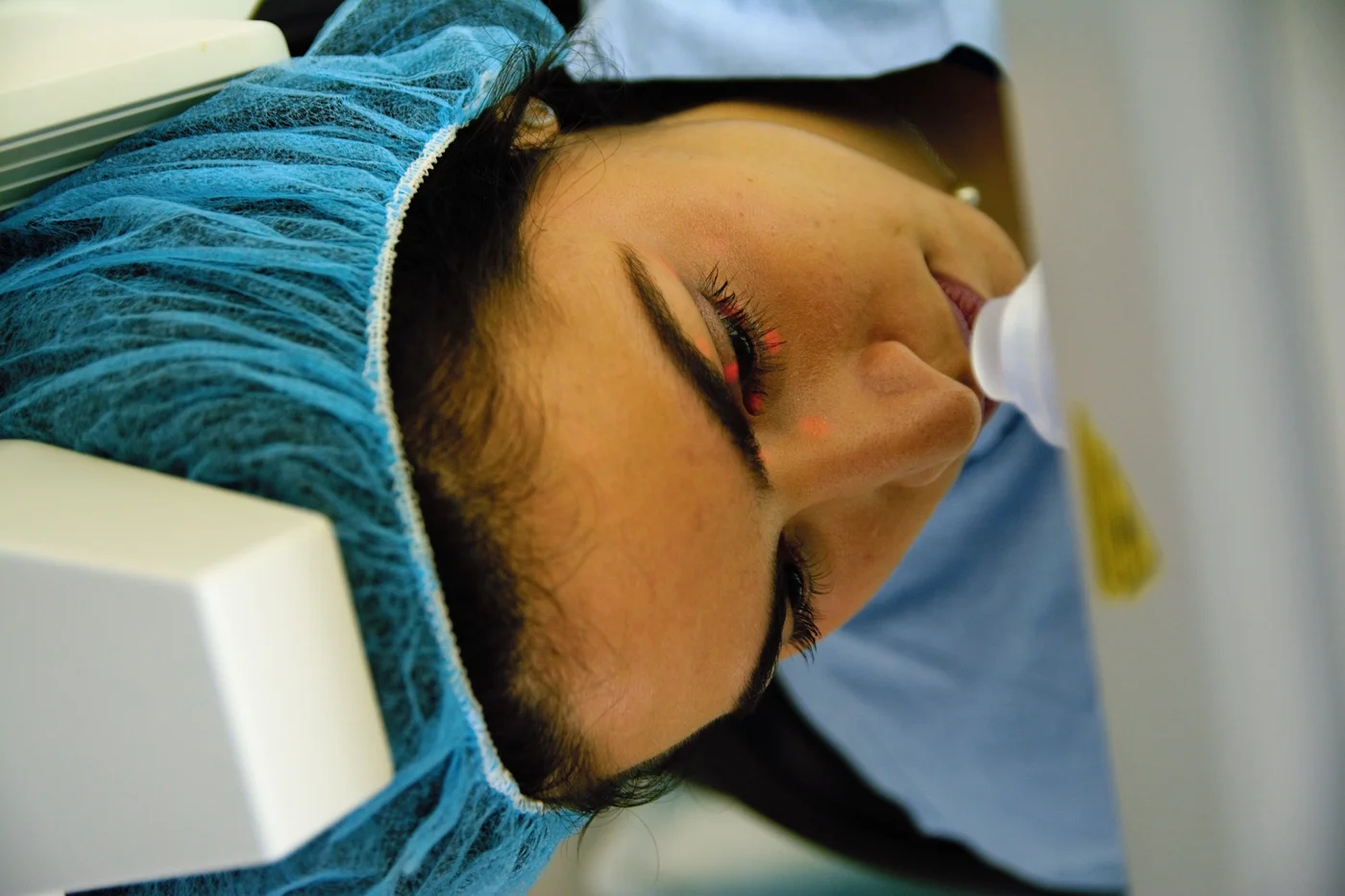
This is where technology changes the game. The iTrace is a ray-tracing aberrometer that allows measurement of the entire eye's optics, not just the corneal surface. In a post-refractive eye, where standard keratometry is unreliable, the iTrace provides information that no other device delivers in the same way.
The equipment projects 256 rays through the eye and analyzes how they refract at each point. This allows the aberrations originating from the cornea to be separated from those generated by the crystalline lens, and a real optical map of the patient to be built. For intraocular lens selection, that information is critical.
The iTrace allows us to make decisions with objective data in patients where conventional biometry simply falls short. It is particularly useful for determining whether a patient is a candidate for a premium lens or whether, given their optical profile, an optimized monofocal lens is the safer option.
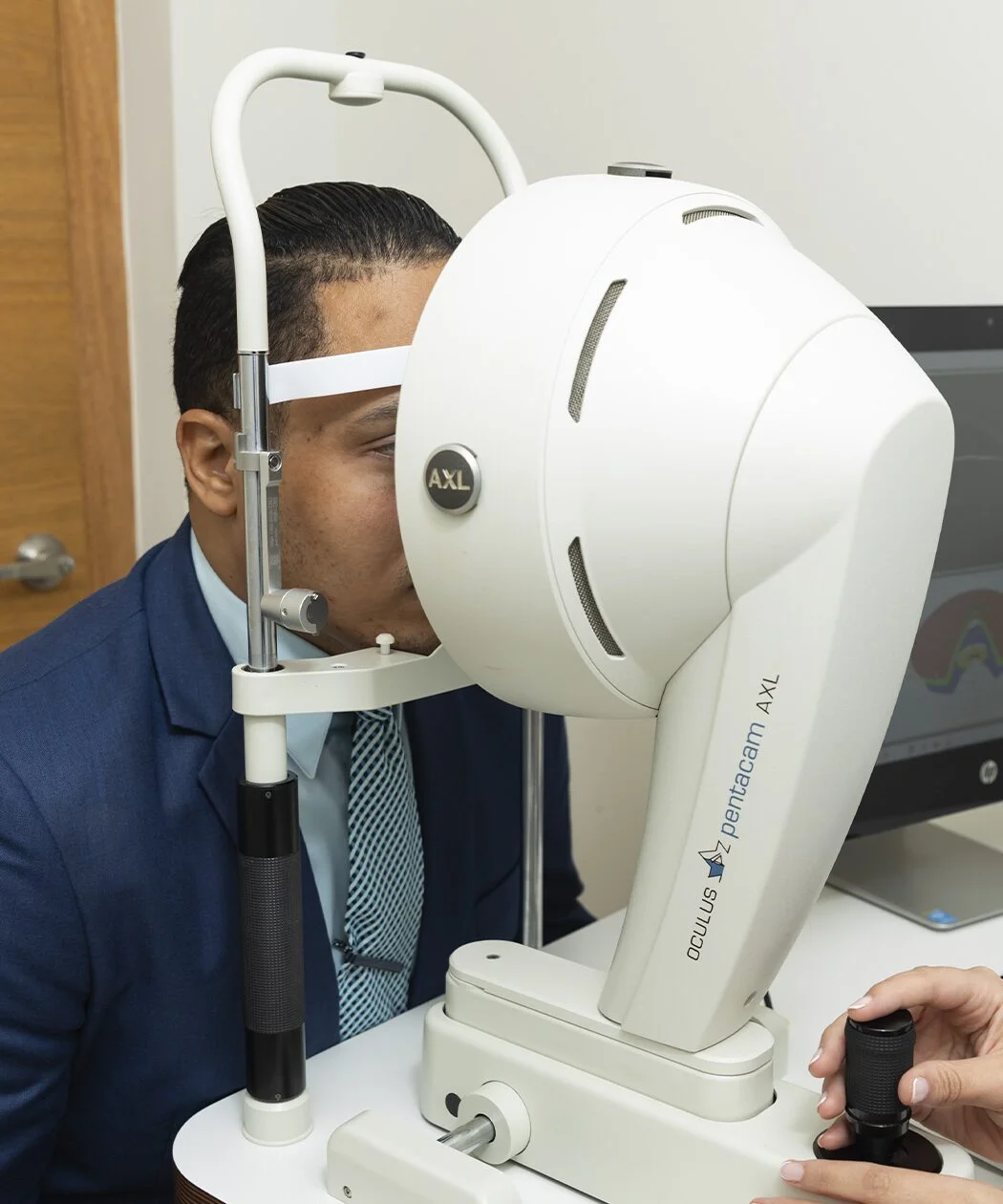
We complement the iTrace with IOL Master biometry (partial coherence interferometry) and anterior segment OCT, which allows us to visualize the corneal structure layer by layer. The combination of these three studies reduces uncertainty to levels that were unthinkable 10 years ago for these cases.
Standard surgery vs. post-refractive cataract: the differences
| Aspect | Standard surgery | Post-refractive surgery |
|---|---|---|
| Cornea | Virgin, predictable curvature | Modified by laser, altered relationship |
| IOL calculation formulas | SRK/T, Holladay, Barrett | Barrett True-K, Haigis-L, ASCRS Calculator |
| Keratometry | Reliable with standard equipment | Requires iTrace, advanced topography |
| Risk of refractive surprise | Low (< 0.5 D in most cases) | Moderate to high without specialized methods |
| Premium lens selection | Based on conventional biometry | Requires aberrometry and corneal analysis |
| Preoperative diagnostics | IOL Master, keratometry | IOL Master + iTrace + OCT + history |
| Surgeon experience | Any trained surgeon | Experience in post-refractive cases |
The central point is that cataract surgery in an eye previously operated with laser is not technically more difficult, it is diagnostically more complex. The surgical act with the Alcon Centurion or Signature Pro phacoemulsifiers remains the same. What changes is everything that happens before entering the operating room.
Intraocular lens options for these patients
Once we have the correct calculation, the lens options are the same as for any cataract patient. We work with extended depth of focus lenses, multifocals (Alcon, Johnson & Johnson Vision, Zeiss), and torics for patients with residual astigmatism.
However, the selection is more conservative. Not all post-refractive patients are good candidates for multifocal lenses, because the preexisting corneal aberrations can generate halos or glare that reduce visual quality. In my experience, I evaluate each case individually with the iTrace before recommending a premium lens. If the aberration map shows significant irregularities, a monofocal or extended depth of focus lens with toric correction usually delivers better functional results than a multifocal.
It is not about implanting the most sophisticated lens, but the right lens for that particular eye. A multifocal in an eye with uncontrolled aberrations can produce more dissatisfaction than a well-calculated monofocal.
At CCCRP we have participated in clinical studies for the development of intraocular lenses, which has given us early access to technologies and, above all, a deep understanding of how these optics behave across different corneal profiles.
Frequently asked questions
Can I have cataract surgery if I had LASIK 20 years ago?
Yes. Prior surgery does not prevent cataract surgery. What it requires is a specialized diagnostic protocol to correctly calculate the intraocular lens. With the appropriate formulas and technology, results can be excellent.
Will the visual outcome be as good as in someone who never had laser surgery?
In most cases, yes. The key is the precision of the preoperative calculation. When specialized formulas and ray-tracing aberrometry are used, the probability of achieving a refraction within 0.5 diopters of target exceeds 85% in published series.
What if I do not have the data from my original laser surgery?
There are formulas that do not require historical data, such as Barrett True-K and Shammas-PL. We can also use the iTrace and corneal topography to estimate the real corneal power. Precision is somewhat lower than when we have complete history, but still significantly better than using standard formulas.
Can I use multifocal lenses if I already had refractive surgery?
It depends on the state of the cornea. If the optical surface is regular and aberrations are within acceptable limits, a multifocal can work very well. If there are irregularities, an extended depth of focus or monofocal toric lens will likely offer better visual quality.
Should I look for a specialized surgeon for this type of cataract?
It is advisable. An ophthalmologist with experience in refractive surgery and access to advanced diagnostic tools has a greater probability of achieving the desired refractive outcome.
References
- American Academy of Ophthalmology. (2024). Cataract in the Adult Eye Preferred Practice Pattern. San Francisco, CA: AAO.
- Wang, L., Koch, D. D., Hill, W., & Abulafia, A. (2020). Pursuing perfection in intraocular lens calculations: III. Journal of Cataract & Refractive Surgery, 46(10), 1462-1468.
- Savini, G., & Hoffer, K. J. (2018). Intraocular lens power calculation in eyes with previous corneal refractive surgery. Eye and Vision, 5, 18.