Refractive surgery · SMILE
SMILE surgery in Santo Domingo
SMILE corrects myopia without creating a flap. I am a national pioneer of the technique, but that does not make it the answer for everyone.
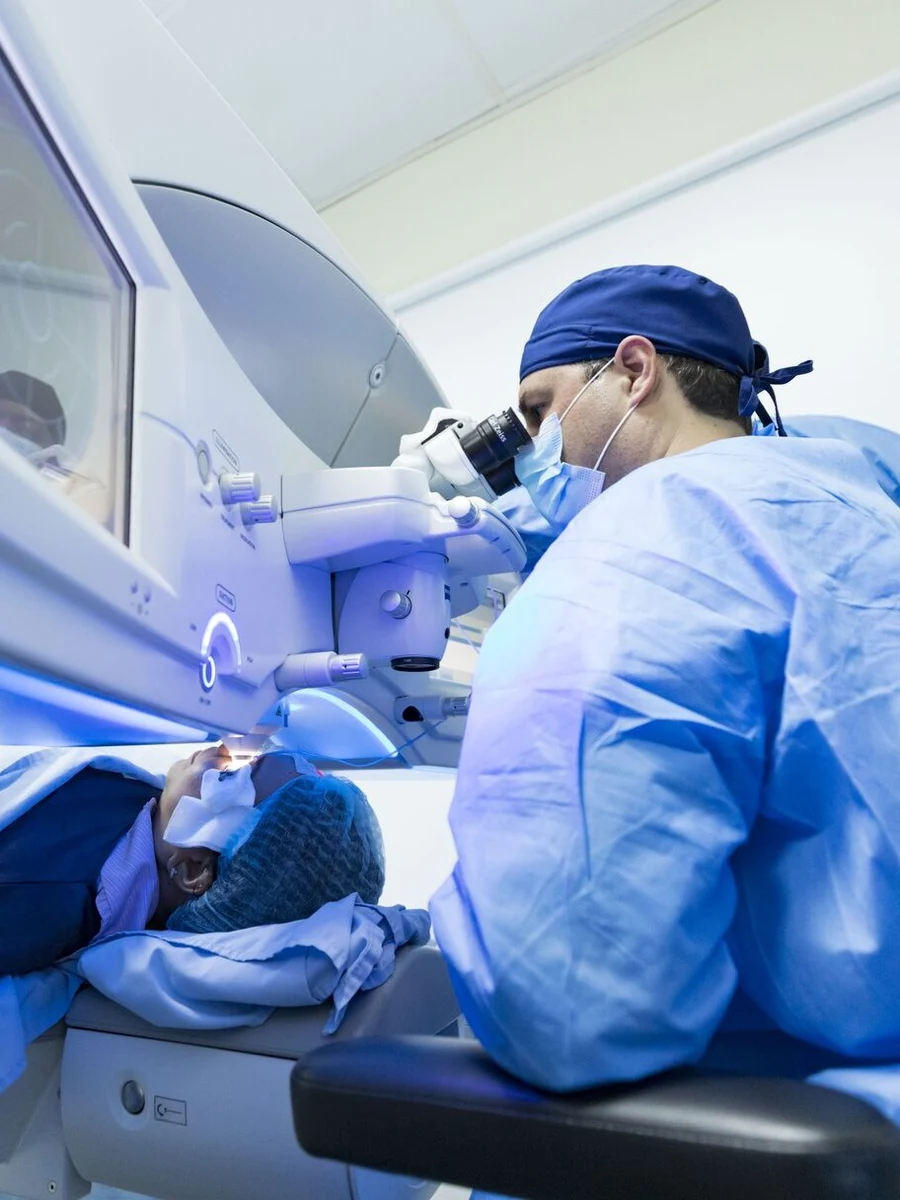
SMILE corrects myopia without creating a flap. I am a national pioneer of the technique, but that does not make it the answer for everyone.
ReLEx SMILE is the most advanced and least invasive laser vision correction technique I have available for myopia. Unlike LASIK, it does not create a flap in the cornea. Instead, the femtosecond laser carves a small tissue disc within the thickness of the cornea, which is extracted through a micro-incision of a few millimeters. By not lifting a flap, the biomechanical integrity of the eye is better preserved and dry eye symptoms in the first months after surgery are reduced.
I am a national pioneer and instructor of this technique in the Dominican Republic. I mention it for context, not as a sales pitch: mastering SMILE gives me the judgment to know when to use it and, above all, when not to.
SMILE shines in myopia with or without astigmatism, within defined ranges, in a healthy cornea with enough thickness. When the prescription falls outside those ranges, when the cornea is thin, or when the topography shows something worth watching, the best answer may be a PRK, an ICL lens, or simply waiting. Preferring the newest technique over the patient’s eye is a mistake I do not make.
This page is for informational purposes and does not replace an ophthalmological evaluation. The indication for SMILE depends on each case and must be individualized in consultation.
A small tissue disc (lenticule) is extracted with a femtosecond laser through a micro-incision of a few millimeters, without lifting a flap.
SMILE corrects myopia accompanied by astigmatism within the ranges approved for the technique.
SMILE has real advantages, but it is not a universal solution. The fact that it is the technique I master most does not make it the one that suits you. This is what defines whether you are a candidate.
SMILE does not require creating a flap, which better preserves the biomechanical integrity of the eye and reduces dry eye symptoms in the first months after surgery. LASIK is still an excellent option in many cases; the choice depends on your cornea.
It corrects myopia and myopic astigmatism within the ranges approved for the technique. It does not correct hyperopia or presbyopia.
Most patients recover good functional vision in a short time. The exact period varies by eye, so postoperative instructions are individualized in consultation.
Write to us and Dr. Batlle Logroño's team will coordinate your cornea or refractive surgery evaluation.
Request an appointment