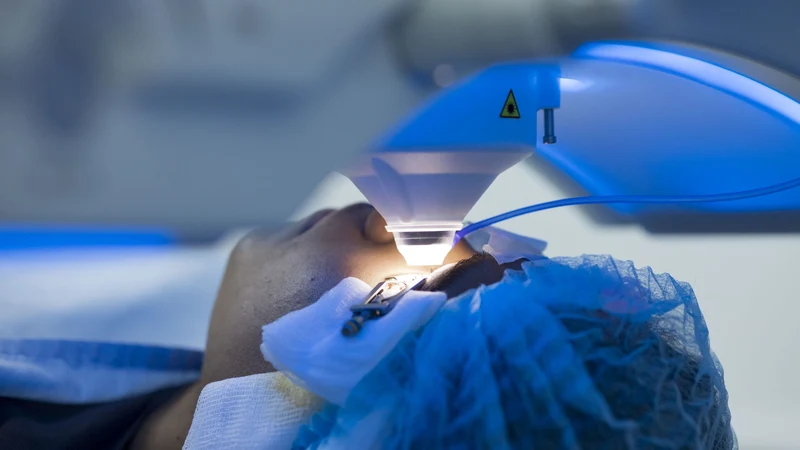
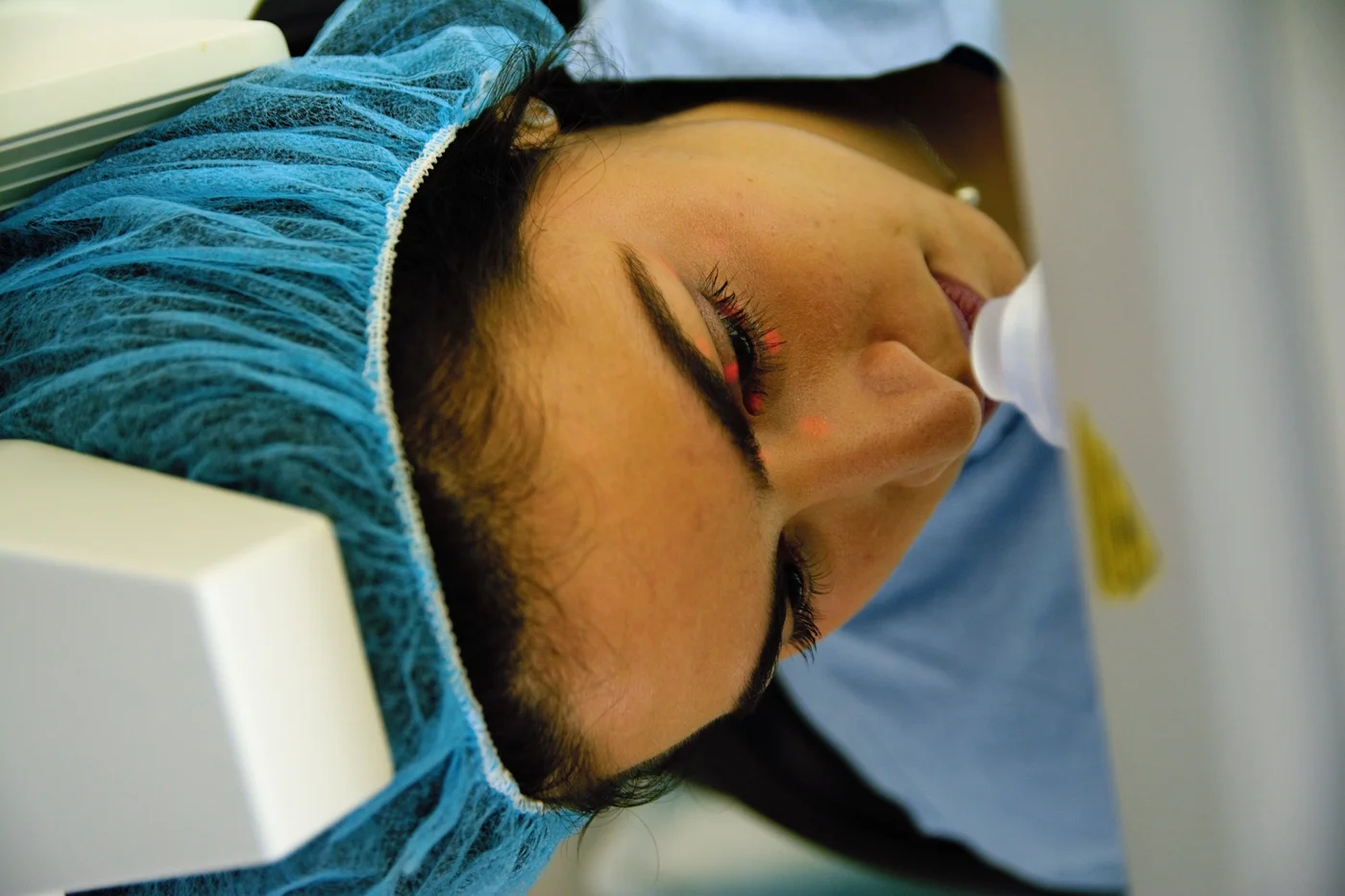
At age 40, a good share of the patients who had LASIK between 2005 and 2015 begin to notice that their near vision no longer responds the same way. Presbyopia comes to everyone, including previously operated eyes, and the scenario is now common in the clinic. The question I receive more and more often is: can that presbyopia be treated with laser again? The short answer is yes, but the long answer depends on what the prior LASIK left in the cornea.
A few weeks ago I saw a case that illustrates that difference well. A 44-year-old patient came to Centro Láser, right eye dominant, with a history of bilateral myopic LASIK. His residual refraction was OD +0.25 −1.00 × 5 with 20/15 vision and OS +0.25 −1.00 × 165 with 20/20 vision. The patient's refractive target was plano in both eyes, but presbyopia was already symptomatic: uncorrected near visual acuity of J3 in both eyes. He tolerated well the monovision trial with the simulated non-dominant left eye at a target of −1.50 diopters. The initial plan was to perform a READ treatment, but that plan never reached the operating room. This article documents why I changed the approach to a CustomQ with flap lift and why the results at one week validate that decision.
Why the initial READ plan was not viable
READ is the excimer laser presbyopia treatment modality that combines moderate monovision with personalized management of corneal asphericity. It works well when there is refractive and geometric margin to work with. In this patient, two findings ruled out READ from the preoperative stage.
The first was refractive: the spherical equivalent of both eyes was slightly negative. When the spherical equivalent is already in the mild myopic zone, there is no functional tissue available for a new significant myopic ablation without compromising residual pachymetry or optical quality. The WaveLight platform does not authorize READ in that range because the calculation falls outside the nominal parameters of the nomogram.
The second was topographic, and in my judgment the most limiting in this patient profile. The Topolyzer showed an oblate cornea as an inheritance of the prior myopic LASIK. A healthy cornea has a prolate profile, where the center is steeper than the periphery. Myopic LASIK flattens the center and, when the original correction was high, leaves a cornea whose central curvature is similar to or even less than the peripheral curvature. That oblateness is what we call induced coma and accumulated positive spherical aberration, and it is the scenario where a more aggressive READ could amplify higher-order aberrations rather than help depth of focus.
"In my experience, when you see an oblate cornea after myopic LASIK, you have to change the question. It is no longer 'how much can I correct?', but 'what shape do I need this cornea to have so the patient sees well up close without losing distance?'."
Dr. Juan F. Batlle Logroño
What CustomQ is and why it changes the conversation
CustomQ is the module of the WaveLight EX500 laser (Alcon) that allows the corneal Q factor to be adjusted in a personalized way as part of the treatment. The Q factor describes the asphericity of the cornea: negative values indicate a prolate profile (center steeper than periphery, ideal for distance vision), values near zero indicate a spherical cornea, and positive values indicate an oblate cornea.
The Q-shifting strategy seeks to intentionally modulate asphericity to induce a controlled amount of spherical aberration. That aberration is not a refractive defect in the classic sense, but a pattern of light distribution that, in a calibrated amount, increases the depth of focus of the eye. In technical terms it is known as primary spherical aberration, denoted S4 in the fourth-order Zernike polynomial. The peer-reviewed literature on presbyLASIK describes this mechanism (with a positive or negative profile depending on the refractive case) as an effective option to extend depth of focus. The choice of a positive SA profile in this patient, over a cornea already treated with myopic LASIK, was a clinical decision based on the asphericity inherited from the prior surgery, not a protocol established in the literature for that specific scenario.
The key piece to understand this case is the following: in CustomQ, you are not treating residual myopia or hyperopia; you are sculpting the shape of the cornea so that each eye has the focusing range that binocularity needs. The dominant eye gains a touch of spherical aberration that improves near without worsening distance. The non-dominant eye receives a controlled hyperopic overcorrection with greater asphericity, which positions it for near tasks with an acceptable compromise at distance.
The surgical plan executed
After ruling out READ, the plan was built around bilateral CustomQ with two different profiles:
- Right eye (dominant): ablation to plano refractively, with the Q adjusted to leave primary spherical aberration close to +0.2 microns. The goal was to preserve distance visual acuity without loss (maintain 20/15 or close) and introduce a minimal margin of depth of focus that the binocular system exploits in near vision.
- Left eye (non-dominant): hyperopic overcorrection of +2.50 diopters. The total programmed treatment was +2.75 −1.00 × 165 (the sum of the baseline residual defect and the planned hyperopic delta). The Q was adjusted to leave spherical aberration close to +0.4 microns, a more aggressive asphericity in this eye because its postoperative role is near vision, not distance.
The most relevant technical choice was not to perform PRK over prior LASIK, but flap lift with retreatment. The difference matters. PRK over an old flap involves removing epithelium over already operated tissue, with a risk of a scarring response (haze) and surface irregularity during re-epithelialization, although the use of mitomycin C has substantially reduced that incidence. Flap lift retreatment, by contrast, lifts the original flap created in the prior surgery and allows direct ablation in the stromal bed, beneath the flap, without touching epithelium. The literature compares both techniques: a recent series reported haze of 3.4% in flap lift versus 10% in PRK over the flap, with the trade-off that flap lift introduces its own risk of epithelial ingrowth of around 8.6% to 13.5%, depending on the series. Timing matters: the risk of ingrowth increases with the time elapsed since the primary LASIK, so in flaps that are several years old some surgeons prefer PRK with MMC. When the original flap is well defined, accessible and without signs of damage, flap lift is usually more predictable and visual recovery faster.
After the bilateral ablation I placed a therapeutic contact lens in each eye, a usual practice in flap lift to optimize repositioning and early comfort. The patient returned at one week, the lenses were removed and results were documented.
Results at the first week
The numbers at seven days postoperatively:
- OD: UCVA 20/20 distance, J3 near
- OS: UCVA 20/25 distance, J1 near
Three readings are worth highlighting for a colleague evaluating this strategy:
First, the distance acuity of the non-dominant eye did not collapse. And that is exactly what is expected in CustomQ with Q-shifting. The programmed hyperopic overcorrection does not translate into equivalent symptomatic myopia because the shape of the cornea (the adjusted Q) is doing much of the depth-of-focus work. The postoperative left eye does not see distance as blurred as an eye intentionally myopized for classic monovision would; it sees with a gentle compromise that the binocular system compensates. It is a clinically relevant behavior because it allows the patient to tolerate the refractive asymmetry without the "dimmed eye" sensation that some describe with monovision at −1.50 or −2.00.
Second, the near acuity of J1 in the OS confirms that the treatment reached the functional goal. J1 is fluent reading without effort. The patient can read newspapers, labels and small screens without glasses in that eye, and the OD at J3 provides binocular support for intermediate and general near tasks.
Third, the minimal spherical aberration induced in the OD did not degrade distance vision. It remains 20/20 uncorrected, and in many cases in my practice this type of discreet adjustment in the dominant eye improves near binocular summation without the cost in distance image quality that does occur when the asymmetry is purely refractive.
CustomQ and the Presbyond question
One criticism circulating in part of the field is that treating presbyopia with laser would require a specific platform such as Zeiss Presbyond, technically known as laser blended vision (LBV). The protocol combines micro-monovision with personalized non-linear aspheric ablation to extend the depth of focus in each eye. The peer-reviewed literature documents its application in hyperopes (up to +6.00 D), emmetropes and myopes up to approximately −8.50 D with astigmatism. It is a good technology and I know well how the case for it is made.
My position is that WaveLight CustomQ with Q-shifting covers the equivalent technical spectrum for an important proportion of laser presbyopia candidates, without requiring an additional platform. In this specific case, there was no baseline hyperopia and yet the non-dominant eye responded as if it had it, because the programmed overcorrection built the necessary refractive and geometric environment. The argument that the patient must have a hyperopic eye to treat presbyopia with laser does not hold when you understand how Q-shifting works.
This is not a universal solution. It is one more option, available for the subgroup of patients in whom the combination of refraction, age, corneal quality and visual motivation allows it. And, like any refractive decision, it depends on the case.
What this case teaches about treatment design
Three principles I apply when a post-LASIK patient with presbyopia comes into the clinic:
- The Topolyzer rules the initial decision. If the cornea is oblate from prior myopic treatment, READ is not the first option. CustomQ with Q-shifting is, because it works with the existing asphericity instead of fighting against it.
- The residual spherical equivalent defines how much refractive margin is left. If it is near zero or slightly negative, the options that require additional myopic treatment close down. Those that require ablation with an aspheric profile (CustomQ) or controlled hyperopic overcorrection remain open.
- The technique matters as much as the refractive plan. Flap lift retreatment when the flap is accessible and healthy. PRK over LASIK is left for cases in which the original flap cannot be accessed or there are folds, microstriae or irregularities that contraindicate lifting it.
This is the same bioptic principle I apply when there is refractive residue after a prior intraocular surgery, where the secondary correction with excimer laser rescues the final visual quality. The philosophy holds: each prior surgery changes the terrain, and the next intervention must read that terrain before planning anything. On that subject I recently wrote a case of PRK after cataract surgery that shares the same rescue logic.
Frequently asked questions
Can presbyopia be treated with laser if I already had LASIK?
In many cases yes, but the decision depends on three factors: the current residual refraction, the shape of the cornea (seen on Topolyzer or Pentacam) and the available corneal thickness. If the cornea became oblate from the prior LASIK, techniques such as CustomQ with Q-shifting are usually preferable to READ. The preoperative evaluation is what sets the correct path.
What is the difference between READ and CustomQ with Q-shifting?
READ combines moderate monovision with asphericity adjustment and requires typical refractive and corneal margins. CustomQ with Q-shifting prioritizes the intentional modification of corneal shape to induce depth of focus through controlled spherical aberration, and it allows work on oblate corneas or when the residual spherical equivalent does not permit additional myopic ablation.
Is CustomQ the same as Presbyond?
They are not identical, but the optical principle is similar: both seek depth of focus through personalized asphericity, not just pure refractive monovision. CustomQ is available on the WaveLight platform (Alcon). Presbyond is from Zeiss and runs on its own platform. Which one to use depends on the available laser and the patient profile; both are valid tools in the hands of a surgeon who understands what each technique is after.
Why choose flap lift instead of PRK over LASIK?
When the original flap from the prior LASIK is accessible and undamaged, lifting it and treating the stromal bed usually gives better postoperative comfort and faster visual recovery than doing PRK over the old flap. Timing matters: in flaps that are several years old the risk of epithelial ingrowth increases, which can tilt the decision toward PRK with mitomycin C. The decision is individualized according to the findings of the original flap and the time elapsed since the primary surgery.
How long does visual recovery take with CustomQ and flap lift?
Typical functional vision returns between three and seven days, with progressive stabilization during the first month. Binocular adaptation to the new configuration (especially in the non-dominant eye with greater asphericity) may take several weeks. In my practice, typical follow-up includes a check at one week, one month, three months and six months.
Medical disclaimer
This article describes an individual clinical case for educational purposes. Surgical decisions in refractive surgery depend on a complete ophthalmological evaluation, including manifest and cycloplegic refraction, corneal topography, pachymetry, diagnosis of higher-order aberrations and personal history. Results vary between patients. Consult an ophthalmologist subspecialized in cornea and refractive surgery before making decisions about laser treatments.
References
- Reinstein DZ, Carp GI, Archer TJ, Gobbe M. LASIK for presbyopia correction in emmetropic patients using aspheric ablation profiles and a micro-monovision protocol with the Carl Zeiss Meditec MEL 80 and VisuMax. J Refract Surg. 2012;28(8):531-541.
- Vinciguerra P, Camesasca FI, Vinciguerra R, et al. Advanced surface ablation with a new software for the reduction of ablation irregularities. J Refract Surg. 2017;33(2):89-95.
- Reinstein DZ, Archer TJ, Gobbe M. Laser blended vision for presbyopia. Cornea. 2014;33 Suppl 11:S20-S26.
- Saib N, Abrieu-Lacaille M, Berguiga M, et al. Femtosecond laser-assisted flap lift retreatment after LASIK. J Refract Surg. 2015;31(11):765-770.
- Stival LR, Lago MC, Carrijo-Carvalho LC, et al. Laser blended vision (Presbyond) for the treatment of presbyopia: a systematic review. Indian J Ophthalmol. 2024;72(Suppl 2):S189-S196.
Clinical case performed at Centro Láser, Santo Domingo. Dr. Juan F. Batlle Logroño is an ophthalmologist subspecialized in cornea and refractive surgery, MD from Tulane University and Fellow of the Bascom Palmer Eye Institute. Co-Director of the Cornea Bank of the Dominican Republic and of CCCRP. National pioneer of ReLEx SMILE in the Dominican Republic.