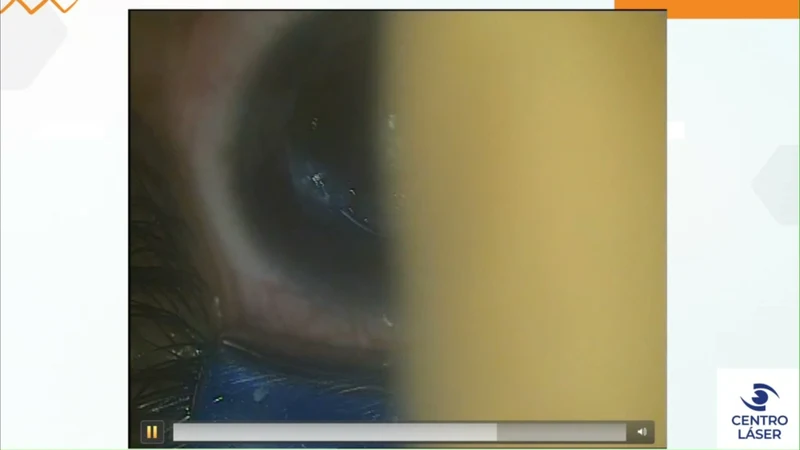
A 78-year-old patient arrived at the operating room in January 2026 with an eye on the verge of anatomical loss. Years earlier, she had suffered severe infectious keratitis treated with a corneal patch. When the outcome did not meet visual goals, she was taken for implantation of a Boston type 1 keratoprosthesis as a last resort to preserve visual function. A few weeks after the prosthesis was placed, she developed a corneal ulcer in the nasal region of the corneal button that rapidly progressed to corneal melting (corneal melt). Progressive tissue thinning produced partial prolapse of the keratoprosthesis, decentration of the optic, and loss of stability of the therapeutic contact lens protecting the surface. There was a high risk of complete extrusion of the prosthesis and, with it, loss of the eyeball.
On January 29, 2026, we performed placement of a tectonic corneal patch covering the area of greatest thinning around the keratoprosthesis. The donor tissue came directly from the Dominican Republic Cornea Bank, of which I am Co-Director, and that logistics is what makes this type of rescue possible within the timeframes a corneal emergency demands. Eight weeks later, the evolution was favorable: no infectious recurrence or progression of thinning, with the prosthesis stabilized and the eyeball preserved. This case illustrates why rigorous follow-up of patients with keratoprosthesis and the ability to intervene surgically on an emergency basis when a melt appears are what separate saving the eye from losing it.
The Boston type 1 keratoprosthesis as a last visual resort
The Boston type 1 keratoprosthesis (Boston KPro type 1) is a device that replaces the central cornea in patients with corneal disease who no longer respond to conventional transplants. It is indicated in cases of repeated keratoplasty failure, infectious keratitis with poor prognosis for classical grafting, severe ocular surface diseases, and patients for whom visual function would be lost without a prosthetic alternative.
Its advantage is clear: it restores vision to eyes that can no longer sustain a biological transplant. Its cost is that it introduces a permanent foreign body into the cornea, with everything that implies in terms of ongoing care. The corneal surface surrounding the optical portion of the prosthesis requires very particular management, and any failure of that surface can compromise the stability of the device.
In our practice, a Boston KPro is a decision we only make when alternatives are exhausted and the patient understands the follow-up commitment that comes with it. When that decision is made well, the visual outcome is often transformative. When complications arise, the margin for maneuver depends on how quickly action is taken.
Corneal melt: the complication that can cost the eye
Corneal melt (also called corneal melting or keratolysis) is a progressive thinning of the corneal stroma. In the context of a Boston type 1 keratoprosthesis, melt is one of the best-documented complications in the literature, with a reported incidence between 2.4% and 30.4% depending on the underlying indication (mean of 13% in combined series, according to the American Academy of Ophthalmology Technology Assessment, 2015). The highest incidences are seen in autoimmune ocular surface diseases and in chemical burn sequelae, which are precisely the groups where the Boston KPro is most frequently indicated.
In the prosthetic eye, melt usually appears in the corneal tissue surrounding the optical portion of the device. The mechanism is multifactorial: chronic inflammatory processes, localized ischemia, superficial infections, and mechanical interaction between the tissue and the prosthesis ring can converge at the same point and produce thinning.
What is critical about melt is that it can progress very quickly. Thinning detected in time is managed with intensive medical treatment and surface adjustments. Thinning that has progressed can mechanically destabilize the prosthesis, cause prolapse, decentration and, in the worst cases, complete extrusion with loss of the eye's contents.
The clinical signs that demand immediate evaluation are:
- Visible thinning of the cornea adjacent to the prosthesis ring
- Change in the position or centration of the optical portion
- Therapeutic contact lens that no longer stays in position
- Signs of persistent inflammation that do not subside with topical treatment
- Any new discomfort in a patient with a previously stable KPro
Timely evaluation can radically change the prognosis. In this specific case, the patient presented with the first three findings simultaneously, which constituted a genuine surgical emergency.
The surgical decision: tectonic patch
When corneal thinning reaches a point where the tissue is no longer structurally sufficient to support the prosthesis, options are limited. Medical treatment will continue to combat the inflammatory or infectious cause, but it will not replenish the tissue that has already been lost. One of the most widely used surgical alternatives in this scenario is the tectonic corneal patch: donor corneal tissue is placed over the thinned area to restore the necessary thickness and mechanical resistance. The literature also describes other rescue techniques in the same spectrum (amniotic membrane, keyhole-type lamellar graft, exchange of the corneal carrier), and the choice depends on the specific pattern of the melt in each case. Without timely intervention, an established melt can progress to exposure of the back plate, aqueous humor leakage, extrusion of the prosthesis, and structural loss of the eyeball.
The goal of the tectonic patch is not optical. It will not improve visual acuity by itself. Its goal is structural:
- Mechanical reinforcement of the thinned zone
- Stabilization of the prosthesis through the support of the reconstructed tissue
- Prevention of progression of the melt to adjacent areas
- Preservation of the eyeball as the ultimate priority
In this patient's case, the January 29, 2026 procedure met all four objectives. The nasal area adjacent to the prosthesis received the donor tissue as a tectonic reinforcement, the prosthesis was stabilized in its original position, and the melt was halted.
Postoperative follow-up and preventive strategy
A successful tectonic patch does not resolve the underlying problem. What it does is buy time and restore structural integrity, but the patient with a KPro still needs the same rigorous follow-up as before. In our post-patch protocol, the patient entered a scheme of frequent check-ups with three priorities:
- Early detection of new infections, which are one of the precipitating factors of recurrent melt
- Surveillance of residual corneal tissue, looking for early changes of thinning in other areas
- Evaluation of keratoprosthesis stability, with follow-up of position, centration, and behavior of the therapeutic contact lens
Up to the close of follow-up in April 2026, the evolution was favorable: no infectious recurrence, no progression of corneal thinning, prosthesis stable in position. The patch fulfilled its function.
The Cornea Bank as critical logistics
A tectonic corneal patch requires donor corneal tissue available at the moment the emergency demands it. That availability is not trivial. A patient with a Boston KPro in melt cannot wait weeks for tissue to arrive, because within that timeframe the prosthesis can extrude. The availability of donor tissue within a short operative window is what turns this type of rescue into a real option.
As Co-Director of the Dominican Republic Cornea Bank, I have direct access to the donor tissue that makes interventions of this nature possible. That logistics is an integral part of the practice I have built: the integration between complex surgical procedures and tissue supply is what makes it possible to offer structural rescues within timeframes that other centers cannot meet.
The Cornea Bank also supplies other procedures we perform regularly at Centro Láser: CAIRS segment implantation in complex cases, surface reconstruction after failed keratoplasty, selective lamellar grafts. In all those scenarios, the availability of qualified donor tissue is a prior condition.
Frequently asked questions
What is a tectonic corneal patch?
It is a surgical procedure in which donor corneal tissue is placed over an area of the cornea that has lost structural thickness, with the aim of mechanically reinforcing the thinned zone. It does not seek to improve vision directly; it seeks to preserve the anatomical integrity of the eye.
Why does corneal melt appear in a patient with a keratoprosthesis?
It is a multifactorial complication. It can originate from chronic inflammatory processes, microinfections, ischemia of the tissue surrounding the prosthesis, or mechanical interaction between the edge of the device and the adjacent stroma. In many cases several factors converge simultaneously.
How long after a melt is there to operate?
There is no fixed timeframe, but intervention must be early. A melt that has progressed to prosthesis prolapse or loss of therapeutic contact lens stability is already in a surgical emergency phase. At that point, every day without intervention increases the risk of extrusion and loss of the eye.
Does the tectonic patch resolve the problem definitively?
It stabilizes the structure and halts progression of the melt, but the patient still needs the same rigorous follow-up as before. The patch does not eliminate the underlying cause that generated the melt, so ongoing monitoring to detect recurrences is critical.
Can any center perform this procedure?
It requires two conditions: specific surgical experience in high-complexity corneal surgery, and rapid access to donor corneal tissue. The second condition is often the limiting factor, because a patient in emergency cannot wait for the usual logistics of tissue procurement.
What this case makes clear
A patient with a Boston keratoprosthesis is a patient who requires lifelong care. The prosthesis restores vision, but it does not restore the original cornea's autonomous capacity to defend itself against infections, inflammation, and ischemia. When those threats present and end in corneal melt, the intervention has to be rapid and surgical. The tectonic patch is the most reliable tool for that structural rescue, and its availability depends as much on surgical experience as on donor tissue logistics.
If you or a family member is a Boston keratoprosthesis wearer and notices visible corneal thinning, a change in the position of the device, or new persistent discomfort, consult urgently. Time is the factor that weighs most in these cases.
About the author
Dr. Juan F. Batlle Logroño is an ophthalmologist specialized in cornea and refractive surgery. A medical graduate of Tulane University and Fellow of the Bascom Palmer Eye Institute, he is Co-Director of CCCRP and Medical Director of the Dominican Republic Cornea Bank. He practices at Centro Láser, an ophthalmology institution with more than 50 years of experience in the country, where he leads the cornea and refractive surgery program. His practice includes high-complexity structural rescues, with direct access to donor tissue from the Cornea Bank for surgical emergency interventions.
Legal notice
This content is intended for educational and informational purposes. It does not replace professional ophthalmology consultation, diagnosis, or treatment. Boston keratoprosthesis wearers require continuous specialized follow-up; surgical decisions in the face of complications must be made with a cornea specialist experienced in KPro. The outcomes described correspond to a specific patient and may vary according to the clinical conditions of each individual.
References
- Chan CC, LoVerde L, Qiang J, Nordlund ML, Holland EJ. Incidence, Risk Factors, and Surgical Management of Boston Type 1 Keratoprosthesis Corneal Melts, Leaks, and Extrusions. Cornea. 2016;35(9):1165-72. PMID: 27391092.
- Bouhout S, Robert MC, Deli S, Harissi-Dagher M. Corneal Melt after Boston Keratoprosthesis: Clinical Presentation, Management, Outcomes and Risk Factor Analysis. Ocul Immunol Inflamm. 2018;26(5):693-699. PMID: 28080168.
- Greiner MA, Li JY, Mannis MJ. Boston Keratoprosthesis: Outcomes and Complications: A Report by the American Academy of Ophthalmology. Ophthalmology. 2015. PMID: 25934510.
- Nonpassopon M, Niparugs M, Cortina MS. Boston Type 1 Keratoprosthesis: Updated Perspectives. Clin Ophthalmol. 2020;14:1189-1200. PMC7196770.
- John T, et al. Keyhole Anterior Lamellar Keratoplasty for Boston Keratoprosthesis Corneal Melt. PMC8495233.
Last updated: April 17, 2026